Case study area profiles:
Antwerp – Athens – Budapest – Copenhagen – Istanbul – Leipzig – London – Milan – Paris – Rotterdam – Tallinn – Toronto – Warsaw – Zurich
MILAN
Milan, with its 1.4 million inhabitants, is the second largest city, the largest metropolitan area in Italy (4.3 million), and the regional capital of the Lombardy region. Already an important city in the Late Antiquity, it kept its important role connecting trade and production throughout its history. Between the 19th and 20th centuries, it became the ‘economic capital’ of Italy, a focal point for the industrialisation and modernisation of the country, being both a blue- and a white-collar city.
Whilst being an important industrial centre, Milan was also early in its tertiarisation process: it is the headquarters for many important financial institutions (e.g. the Italian stock exchange) and the Italian capital of fashion, design and media industries – features that made its name world-famous, together with its cultural institutions (eg. the La Scala opera house).
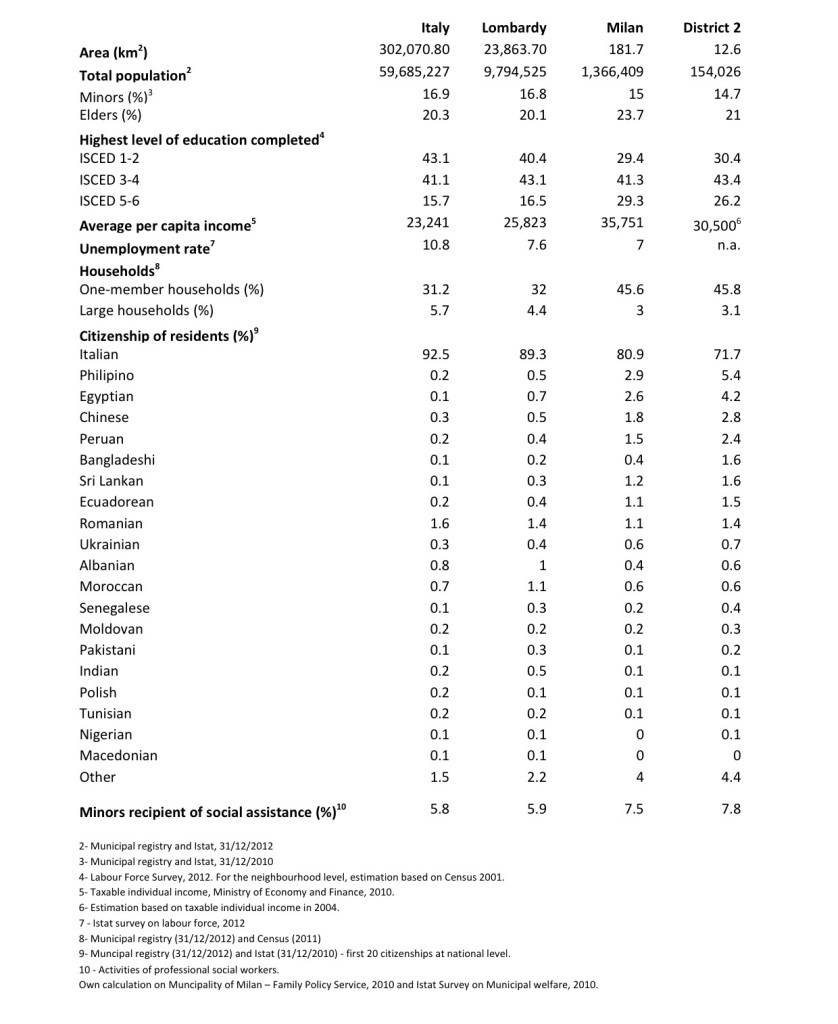
The province of Milan has consistently been the wealthiest of the country: its per capita GDP the highest in Italy (approx. 80% higher than the national average). However, this hasn’t necessarily meant that wealth is equally distributed. Compared to other Italian cities, Milan has an unbalanced income distribution: the richest 10% owns 40% of the income; their income is 22 times larger than that of the poorest 10% (a Gini index of 0.51, by far the highest among the largest Italian metropolitan areas. ) In summary, there is a rich upper class (richer than in other Italian cities), and an uneven distribution of wealth.
As an important industrial and tertiary hub, Milan has been attracting in-migrants from the post-war period, first internal and then international. Nowadays, it hosts 260,000 foreign residents, from different areas: the first 10 origin countries account for two-thirds of resident foreigners.
Foreign residents make up 19% of the total municipal population, with a diversity more and more visible in the urban and social fabric. It is both a place where tensions took place (e.g. the riots in the so-called “Chinatown” of Via Sarpi in 2007), but also where activism of new generations of hyphenated Milanese and Italians is more visible.
Our fieldwork will take place mostly in the Northern area of Milan, where the administrative Districts 2, 8 and 9 are located. We will focus mainly on Zona 2 (District 2), in the north-eastern area of the city, which connects Milan with various manufacturing plants in its metropolitan area (from Sesto San Giovanni to Monza-Brianza). The industrial character of the area is more and more fading, and a process of tertiarisation of brown lands has started (e.g. the Pirelli area).
Intersected by various transport lines, it is a very mixed and differentiated area, which had a dramatic development in the second half of 20th century. Some of the neighbourhoods in the district were autonomous municipalities till the early 20th century, and have been ‘swallowed up’ by the big city during booming years.
The presence of transport facilities and of some deteriorating housing eased the settlement of international migrants. Nowadays, 28% of residents are foreigners – by far the highest share among Milan districts. It, also has a peculiar profile: together with nearby District 9, it has the highest share of male migrants, but also the highest share of young children with foreign citizenship.
Key Statistics: